

What Does A Ribosome Do In An Animal Cell
Click to view a enquiry level microscope image, interpreted using CIMR GridPoint engineering
Quick look:
A ribosome functions as a micro-machine for making proteins. Ribosomes are composed of special proteins and nucleic acids. The TRANSLATION of information and the Linking of AMINO ACIDS are at the heart of the poly peptide production process. A ribosome, formed from two subunits locking together, functions to: (1) Translate encoded information from the cell nucleus provided past messenger ribonucleic acid (mRNA), (ii) Link together amino acids selected and nerveless from the cytoplasm by transfer ribonucleic acid (tRNA). (The order in which the amino acids are linked together is determined past the mRNA) and, (3) Export the polypeptide produced to the cytoplasm where it will form a functional protein.
Ribosomes are institute 'costless' in the cytoplasm or jump to the endoplasmic reticulum (ER) to class rough ER. In a mammalian jail cell there can be as many equally 10 meg ribosomes. Several ribosomes can be attached to the same mRNA strand, this construction is called a polysome. Ribosomes have only a temporary existence. When they have synthesised a polypeptide the two sub-units split up and are either re-used or broken upwards.
Ribosomes can bring together up amino acids at a rate of 200 per minute. Modest proteins can therefore be made fairly quickly only ii to three hours are needed for larger proteins such equally the massive 30,000 amino acrid muscle protein titin.
Ribosomes in prokaryotes utilize a slightly dissimilar procedure to produce proteins than do ribosomes in eukaryotes. Fortunately this difference presents a window of molecular opportunity for assail past antibiotic drugs such every bit streptomycin. Unfortunately some bacterial toxins and the polio virus also apply it to enable them to attack the translation machinery.
For an overview diagram of protein product click here.
(The diagram volition open up in a separate window)
-
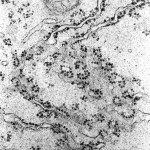
This is an electron microscope paradigm showing part of the rough endoplasmic reticulum in a plant root cell from maize. The dark spots are ribosomes.
(courtesy of Chris Hawes, The Research School of Biology & Molecular Sciences, Oxford Brookes University, Oxford, UK)
A LONGER Await at Ribosomes:
Ribosomes are macro-molecular production units. They are composed of ribosomal proteins (riboproteins) and ribonucleic acids (ribonucleoproteins). The word ribosome is made from taking 'ribo' from ribonucleic acrid and adding it to 'soma', the Latin word for body. Ribosomes tin be bound by a membrane(s) but they are non bleary.
Ribosome: a micro-machine for manufacturing proteins
A ribosome is basically a very complicated but elegant micro-'motorcar' for producing proteins. Each consummate ribosome is constructed from ii sub-units. A eukaryotic ribosome is equanimous of nucleic acids and about eighty proteins and has a molecular mass of about four,200,000 Da. About two-thirds of this mass is composed of ribosomal RNA and i tertiary of most 50+ unlike ribosomal proteins.
Ribosomes are found in prokaryotic and eukaryotic cells; in mitochondria, chloroplasts and bacteria. Those found in prokaryotes are generally smaller than those in eukaryotes. Ribosomes in mitochondria and chloroplasts are similar in size to those in bacteria. There are about 10 billion protein molecules in a mammalian jail cell and ribosomes produce most of them. A apace growing mammalian cell can comprise about 10 1000000 ribosomes. [A single cell of Eastward. Coli contains about 20,000 ribosomes and this accounts for about 25% of the total cell mass].
The proteins and nucleic acids that form the ribosome sub-units are made in the nucleolus and exported through nuclear pores into the cytoplasm. The 2 sub-units are unequal in size and exist in this state until required for use. The larger sub-unit is well-nigh twice as big equally the smaller i.
The larger sub-unit has mainly a catalytic office; the smaller sub-unit of measurement mainly a decoding i. In the large sub-unit ribosomal RNA performs the office of an enzyme and is termed a ribozyme. The smaller unit links up with mRNA and then locks-on to a larger sub-unit. Once formed ribosomes are non static units. When production of a specific protein has finished the two sub-units separate and are so usually broken down. Ribosomes accept only a temporary existence.
Sometimes ribosome sub-units admit mRNA as soon as the mRNA emerges from the nucleus. When many ribosomes do this the structure is called a polysome. Ribosomes can office in a 'costless' state in the cytoplasm only they tin also 'settle' on the endoplasmic reticulum to course 'rough endoplasmic reticulum'. Where there is rough endoplasmic reticulum the association between ribosome and endoplasmic reticulum (ER) facilitates the further processing and checking of newly made proteins by the ER.
The Protein Factory: site and services.
All factories demand services such as gas, h2o, drainage and communications. For these to exist provided there must a location or site.
Poly peptide production also needs service requirements. A site requiring the provision of services is produced in a pocket-sized ribosome sub-unit when a strand of mRNA enters through 1 selective fissure, and a strand of initiator tRNA through another. This action triggers the small sub-unit of measurement to lock-on to a ribosome large sub-unit of measurement to form a consummate and active ribosome. The astonishing procedure of protein production can now begin.
For translation and protein synthesis to accept place many initiator and release chemicals are involved, and many reactions using enzymes have place. At that place are however general requirements and these accept to be satisfied. The list below shows the chief requirements and how they are provided:
- Requirement: A rubber (contagion free) and suitable facility for the protein production procedure to take place.
- Provision: this facility is provided by the two ribosomal sub-units. When the two sub-units lock together to form the complete ribosome, molecules entering and exiting can only practise so through selective clefts or tunnels in the molecular structure.
- Requirement: A supply of information in a class that the ribosome tin translate with a loftier degree of accurateness. The translation must be authentic in order that the correct proteins are produced.
- Provision: Information is supplied past the nucleus and delivered to the ribosome in the class of a strand of mRNA. When mRNA is formed in the nucleus introns (non-coding sections) are cut out, and exons (coding sections) are joined together by a process chosen splicing.
- Requirement: A supply of amino acids from which the ribosomal mechanism can obtain the specific amino acids needed.
- Provision: Amino acids, mainly supplied from food, are normally freely available in the cytoplasm.
- Requirement: A arrangement that tin can select and lock-on to an amino acrid in the cytoplasm and deliver information technology to the translation and synthesis site in the ribosome.
- Provision: Curt strands of transfer ribonucleic acid (tRNA) made in the nucleus and available in the cytoplasm human activity as 'adaptor tools'. When a strand of tRNA has locked on to an amino acid the tRNA is said to be 'charged'. tRNA diffuses into the smaller ribosome sub-unit of measurement and each brusque tRNA strand volition deliver ONE amino acid.
- Requirement: A means of releasing into the cytoplasm: (a) a newly formed polypeptide, (b) mRNA that has been used in the translating process, and (c) tRNA that has delivered the amino acid it was carrying and is now 'uncharged'.
- Provision: (a) when a newly formed peptide chain is produced deep inside the ribosome large sub-unit, information technology is directed out to the cytoplasm forth a tunnel or cleft. (b) 'Used' mRNA leaves the smaller ribosome sub-unit through a tunnel on the side opposite to its point of entry. Movement through the ribosome is brought nigh by a ane-way only, intermittent movement of the ribosome forth, and in the direction of, the incoming mRNA strand.(c) tRNA in the 'uncharged' state leaves via a tunnel in the molecular architecture of the ribosome large sub-unit.
The Protein Manufacturing plant: What happens on the within?
– A look at the protein product line that can join up amino acids at a rate of 200 per minute!
At present we have considered the requirements and provisions needed for the protein production motorcar to operate, we can await at the inner workings.
As mentioned earlier many detailed biochemical reactions accept place in the ribosome and only a brief outline is given here to illustrate the concept.
(Please also see 'schematic of ribosome' at stop of section)
In the ribosome in that location are THREE STAGES and Three operational SITES involved in the protein production line.
The three STAGES are (1) Initiation, (2) Elongation and (3) Termination.
The three operational or binding SITES are A, P and Due east reading from the mRNA entry site (conventionally the correct hand side).
Sites A and P span both the ribosome sub-units with a larger part residing in the ribosome large sub-unit, and a smaller part in the smaller sub-unit. Site Due east, the go out site, resides in the big ribosome sub-unit.
Table of binding sites, positions and functions in a ribosome
(please too run across schematic of ribosome at terminate of section)
| Binding Site | mRNA strand entry site | Biological term | Main processes |
| Site A | 1st | Aminoacyl | Access of codon of mRNA & 'charged' strand of tRNA. Checking and decoding and outset of 'handing over' one amino acid molecule |
| Site P | 2nd | Peptidyl | Peptide synthesis, consolidation, elongation and transfer of peptide chain to site A |
| Site E | 3rd | Go out-to cytoplasm | Training of 'uncharged' tRNA for get out |
The Three stages:
- Initiation. During this stage a small ribosome sub-unit links onto the 'start end' of an mRNA strand. 'Initiator tRNA' as well enters the modest sub-unit. This complex then joins onto a ribosome large sub-unit of measurement. At the beginning of the mRNA strand in that location is a 'kickoff translating' message and a strand of tRNA 'charged' with one specific amino acid, enters site A of the ribosome. Production of a polypeptide has at present been initiated.For the tRNA not to be rejected the three alphabetic character code group it carries (called an anti-codon) must friction match upward with the three letter code group (called a codon) on the strand of mRNA already in the ribosome. This is a very important office of the translation process and information technology is surprising how few 'errors of translation' occur. [In general the particular amino acid it carries is determined by the three letter anticodon it bears, e.k. if the three letter of the alphabet lawmaking is CAG (Cytosine, Adenine, Muanine) then it will select and transport the amino acid Glutamine (Gln)].
- Elongation.This term covers the period between initiation and termination and information technology is during this time that the master part of the designated protein is fabricated. The process consists of a serial of cycles, the total number of which is determined by the mRNA. I of the principal events during elongation is translocation. This is when the ribosome moves along the mRNA by 1 codon notch and a new wheel starts.During the 'get-go-upwardly' process the 'initiation tRNA' will take moved to site P (run into schematic of ribosome at end of section) and the ribosome volition have admitted into site A, a new tRNA 'charged' with one amino acid.The 'charged' tRNA resides in site A until it has been checked and accepted (or rejected) and until the growing peptide chain attached to the tRNA in site P, has been transferred across by enzymes, to the 'charged' tRNA in site A. Hither one new amino acrid is donated by the tRNA and added to the peptide chain. By this process the peptide chain is increased in length by increments of ane amino acid. [The peptide bond formation betwixt the growing peptide chain and the newly admitted amino acid is assisted past peptidyl transferase and takes place in the large ribosome sub-unit. The reaction occurs between tRNA that carries the nascent peptide concatenation, peptidyl-tRNA and the tRNA that carries the incoming amino acrid, the aminoacyl-tRNA]. When this has taken identify the tRNA in site P, having transferred its peptide concatenation, and now without whatever attachments, is moved to site E the exit site.Side by side, the tRNA in site A, consummate with a peptide concatenation increased in length by one amino acid, moves to site P. In site P riboproteins deed to consolidate the bonding of the peptide concatenation to the newly added amino acid. If the peptide chain is long the oldest part will be moved out into the cytoplasm to exist followed by the remainder of the chain every bit it is produced.The next cycle
With site A now empty translocation takes place. The ribosome moves on by a distance of one (3 letter) codon notch along the mRNA to bring a new codon into the processing surface area. tRNA 'charged' with an attached amino acid at present enters site A, and provided a satisfactory match of the mRNA codon and tRNA anti-codon is fabricated, the cycle starts again. This process continues until a termination stage is reached. - Termination. When the ribosome reaches the end of the mRNA strand, a terminal or 'end of protein lawmaking' message is flagged upwards. This registers the end of production for the particular protein coded for by this strand of mRNA. 'Release factor' chemicals foreclose whatever more amino acid additions, and the new protein (polypeptide) is completely moved out into the cytoplasm through a cleft in the large sub-unit. The 2 ribosome sub-units disengage, separate and are re-used or cleaved down.

Summary:
- Almost all the proteins required by cells are synthesised by ribosomes. Ribosomes are plant 'free' in the cell cytoplasm and besides attached to crude endoplasmic reticulum.
- Ribosomes receive information from the cell nucleus and construction materials from the cytoplasm.
- Ribosomes interpret information encoded in messenger ribonucleic acid (mRNA).
- They link together specific amino acids to course polypeptides and they export these to the cytoplasm.
- A mammalian cell may incorporate as many as 10 million ribosomes, but each ribosome has just a temporary being.
- Ribosomes can link upwards amino acids at a rate of 200 per infinitesimal.
- Ribosomes are formed from the locking of a small sub-unit on to a big sub-unit. The sub-units are normally bachelor in the cytoplasm, the larger one being nearly twice the size of the smaller one.
- Each ribosome is a complex of ribonucleoproteins with ii-thirds of its mass is composed of ribosomal RNA and almost one-third ribosomal poly peptide.
- Protein product takes place in three stages: (1) initiation, (2) elongation, and (iii) termination.
- During peptide production the ribosome moves along the mRNA in an intermittent process called translocation.
- Antibody drugs such equally streptomycin can be used to attack the translation mechanism in prokaryotes. This is very useful. Unfortunately some bacterial toxins and viruses can also exercise this.
- After they exit the ribosome most proteins are folded or modified in some way. This is chosen 'post translational modification'.
-
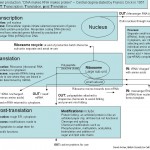
An overview diagram of protein product, including a note about protein modification.
Source: https://bscb.org/learning-resources/softcell-e-learning/ribosome/#:~:text=A%20ribosome%20functions%20as%20a,of%20the%20protein%20production%20process.
Posted by: youngthadders.blogspot.com
0 Response to "What Does A Ribosome Do In An Animal Cell"
Post a Comment